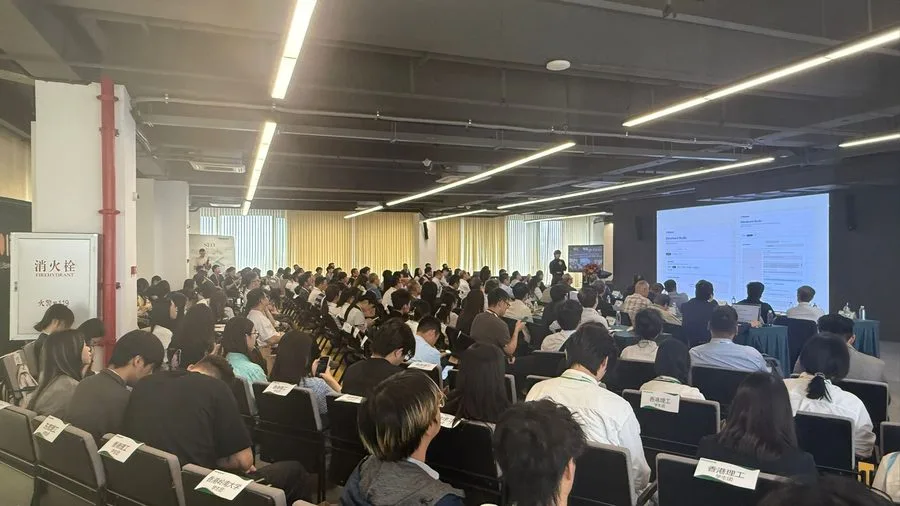
Short answer. Lifewood Tech Talk 2026 was an industry conference on AI data, answer-engine visibility, and AI-generated content, hosted by Lifewood Data Technology on 21 May 2026 in Dongguan. Three talks covered the shift from search to AI answers, how Lifewood keeps AIGC compliant through human review, and how AIGC moves from a loose prompt into a governed production workflow.

Key takeaways
- Lifewood Tech Talk 2026 ran three and a half hours, from 09:30 to 13:00 on 21 May 2026, at the 521 Technology & Finance Center in Songshan Lake, Dongguan.
- The event's AEO and GEO talk introduced AIBE (AI-Based Brand Equity), a model for measuring brand strength inside large language model answers across four dimensions: Visibility, Positioning, Consistency, and Authority.
- A GEO benchmark cited at the event, Aggarwal et al.'s study at ACM KDD 2024, found that adding authoritative quotations lifted AI visibility by up to 40% and adding statistics lifted it by about 30%.
- Lifewood delivered 414,120 training hours to its Bangladesh workforce in 2025, covering 100% of that workforce, as part of the AIGC compliance session's case for mandatory human review.
- A 20-step, three-layer operational framework was presented for moving AIGC from an ad hoc prompt into a governed production system with human sign-off at each stage.
What is AEO and GEO, and why did the event focus on them?
Answer Engine Optimization (AEO) is the practice of structuring content so AI answer engines can extract and cite it directly, and Generative Engine Optimization (GEO) is the broader discipline of making a brand's information retrievable and quotable by generative AI systems. The event focused on both because search behaviour is shifting from a ranked list of links to a single synthesized answer, and a source that isn't structured for extraction cannot be cited even when its underlying facts are correct.
The opening session used a Chinese title, 被发现、被解答、被选择, translating to "Be Discovered. Be Answered. Be Chosen." Its central image was that the search engine is evolving from a librarian into an analyst: a librarian matched keywords to maximize clicks, while an analyst reads semantic structure and entity endorsements, then cites the most trustworthy source inside the answer itself. The deck framed this shift as large-scale, projecting an AEO/GEO market forecast above $50 billion over the next ten years carved out of a global SEO pool worth more than $175 billion, and cited McKinsey's estimate that generative AI could add roughly $463 billion in annual marketing productivity value. That estimate is consistent with McKinsey's published research on the economic potential of generative AI in marketing.
How is AI changing search click behaviour?
AI answer surfaces are absorbing a growing share of searches that would previously have produced a click to a website. The deck reported that search impressions rose 49% after AI Overviews arrived, while click-through on traditional organic results fell 30% over the same period, and that an estimated 60% of searches in the US and Europe were projected to end with zero clicks in 2025, rising to as much as 77% on mobile. Readers weighing the practical difference between the disciplines built for this shift can compare generative engine optimization against classic SEO and AEO.
What did the AEO and GEO talk say about brand strategy?
The talk argued that brand equity is being repriced from a share of customer mindshare to a share of the answer an AI model gives. AIBE (AI-Based Brand Equity) is the model the session introduced for tracking that shift, scored across Visibility, Positioning, Consistency, and Authority. As one translated line from the deck put it: in the past, brands fought for a share of the consumer's mind; in future they fight for a share of the AI's answer — a framing closely related to the Share-of-Answer metric some AI visibility teams now track directly.
The evidence behind that argument came from Aggarwal et al., GEO: Generative Engine Optimization, ACM KDD 2024, a 10,000-query benchmark. Adding authoritative quotations lifted AI visibility by up to 40%, adding statistics lifted it by about 30%, and improving fluency added 15% to 30%. Keyword stuffing offered little to no gain (about 10% worse than baseline on one Perplexity.ai metric in the same paper). The closing line of the session, translated in full, argued that this new era no longer rewards traffic manipulation — it rewards structured truth. The deck also warned that execution is systems engineering, not a one-off task: a human-in-the-loop pipeline running generation, fact-checking, structured-data encoding, and model ingestion against a 95%+ quality threshold, because a wrong fact that enters a model's training corpus hardens into hallucination and is difficult to erase. Teams building that pipeline can see how the full guide to generative engine optimization lays out the same steps in more depth.
How does Lifewood keep AI-generated content compliant and human-reviewed?
Lifewood keeps AIGC compliant by treating human review as a legal requirement rather than an optional safeguard. AIGC (AI-Generated Content) is content produced by generative AI systems, and the risk session at the event mapped the regulatory landscape around it: the US FTC's zero-AI-exemption stance, the EU AI Act's mandatory human oversight requirement, and China's PIPL filing regime. One boxed line from the deck summed up the argument: the missing fact in the AIGC market is the human-in-the-loop, and it is now a legal prerequisite rather than a preference.
The session then connected that argument to Lifewood's own delivery footprint. Lifewood's company profile traces the business from its 2004 founding in Hong Kong to impact hubs employing people across Bangladesh, Benin, and Madagascar. During 2025 Lifewood delivered 414,120 training hours to its Bangladesh workforce, covering 100% of that workforce, with wages reported at two to four times local benchmarks and zero work-related fatalities. The session's closing line was: Shared Success is Sustainable Success. The same review discipline sits behind Lifewood's quality assurance process.
How does AIGC move from a prompt into a governed system?

AIGC becomes a system, rather than a loose creative tool, when generation is embedded inside a workflow with defined checkpoints and human sign-off. The session opened with adoption data: 88% of companies use AI in at least one business function, yet only about 33% are scaling AI programs broadly and just 23% are scaling agentic systems specifically — a gap the speaker read as evidence that most organisations are still experimenting rather than operating AIGC as infrastructure.
The centerpiece of the talk was a 20-step operational framework across three layers: client intake, an automated generation block with human review of keyframes, and a human oversight layer ending in final sign-off. Raw client data stays internal, and external AI tools receive only approved, summary-based prompts. A bilingual slide stated the thesis in both languages — 从提示到系统, "From Prompt to System" — because systematization is described as the competitive edge in the AIGC era. Two demo films closed the session, one subtitled in Swahili and one set in Ming Dynasty China, both produced through the same pipeline.
Which numbers defined the morning?
The event's argument can be read directly from the figures its speakers presented, summarised below.
| Signal | Measured value |
|---|---|
| Search impressions after AI Overviews arrived | Impressions reported up 49% while traditional click-through fell 30%. |
| Zero-click share of US and European searches in 2025 | An estimated 60% overall, and up to 77% on mobile. |
| Forecast AEO/GEO market over the next 10 years | Above $50 billion, carved from a $175 billion SEO pool. |
| Visibility lift from adding authoritative quotations, per KDD 2024 | Up to 40%, with statistics adding about 30%. |
| Lifewood training delivered in 2025 | 414,120 training hours delivered to the Bangladesh workforce during 2025. |
| Companies using AI in at least one function | Adoption at 88%, with only 23% scaling agentic systems. |
What should brands do after Tech Talk 2026?
Brands should audit where they already appear in AI answers, restructure their published content so it can be extracted cleanly, and add human verification before publishing at any scale. The three sessions shared one arc: buyer questions are migrating from search boxes into answer boxes, those answers are only as trustworthy as the humans who verify them, and the organisations that win will build repeatable systems rather than collect one-off tools. Companies weighing where to start this work sometimes compare a shortlist of established AEO and GEO agencies before choosing a partner or building the function in-house, and can read more on the fundamentals of AEO and GEO directly.